OmniSense-Dual
A dual-wearable pedestrian safety and navigation system combining multi-sensor perception with spatial haptic feedback.
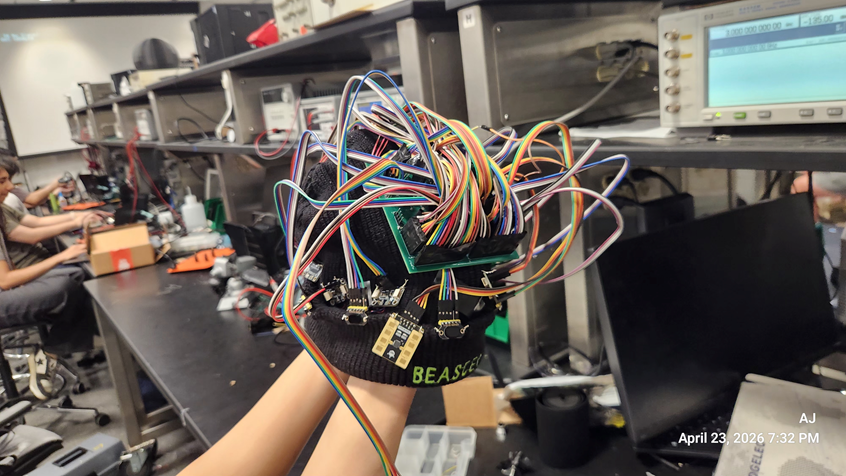
OmniSense-Dual is a two-module wearable designed to help pedestrians—especially visually impaired users—navigate without depending on a screen or adding more audio cues. It separates two kinds of information spatially: a head-worn ring communicates nearby hazards, while a waist belt communicates turn-by-turn navigation.
Built for ECE 445 Senior Design at UIUC (Team 10, Spring 2026) with Jiateng Ma and Simon Xia, the system connects two ESP32-S3 wearables to a Python/Flask host over Wi-Fi.
System architecture
- Head module — hazard awareness: eight directional ToF channels, front and rear mmWave sensing, and IMU orientation data form an obstacle field. Eight head-mounted motors encode both direction and urgency.
- Waist module — navigation: GPS-backed Google Maps guidance is translated into directional cues on an eight-motor belt, keeping navigation physically distinct from hazard warnings.
- Flask host — fusion and coordination: both ESP32-S3 modules send JSON sensor packets over Wi-Fi. The host validates the readings, combines the latest head and waist observations, and returns module-specific haptic commands.
For each of eight compass directions, the fusion pipeline selects the closest valid ToF or mmWave observation. It then merges the head- and waist-level results using the same safety-first rule. IMU data supports orientation and optional tilt-aware filtering, while six distance zones are encoded through motor intensity, pulse frequency, and temporal pattern.
My contributions
My work centered on the software path that turns distributed sensor readings into deterministic feedback:
- Developed the Flask service and JSON interfaces for sensor ingestion, navigation commands, device status, and the real-time dashboard.
- Implemented the dual-module sensor-fusion algorithm, hazard-zone classification, IMU compensation, and eight-direction haptic mapping.
- Built structured verification logging and automated tests that tie system behavior back to the requirements-and-verification plan.
- Designed ToF and power-subsystem tests and contributed to PCB bring-up, wearable assembly, and end-to-end integration.
Verification results
The final prototype was evaluated through bench tests, automated tests, and two recorded walking sessions.
| Metric | Result |
|---|---|
| Recorded sensor packets | 1,986 |
| Malformed packets | 0 |
| Automated tests | 139 |
| Median server processing time | 15.5 ms |
| p95 server processing time | 33 ms |
| Worst ToF distance error from 0.5–2 m | 2.0% |
Prototype gallery
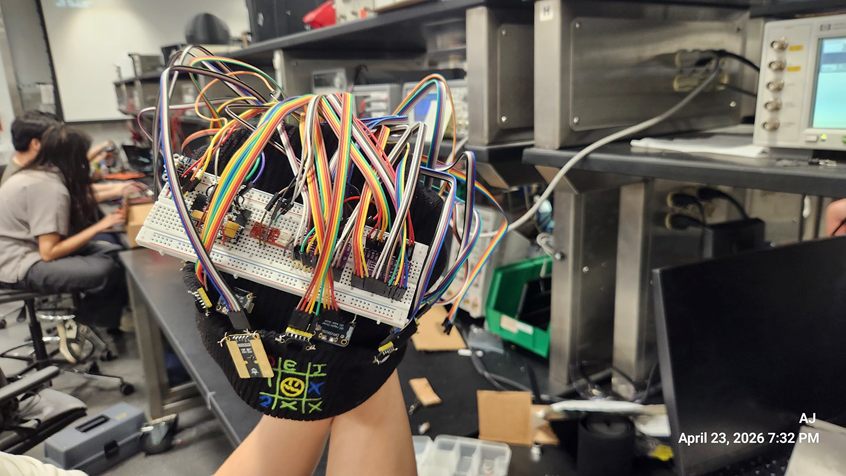
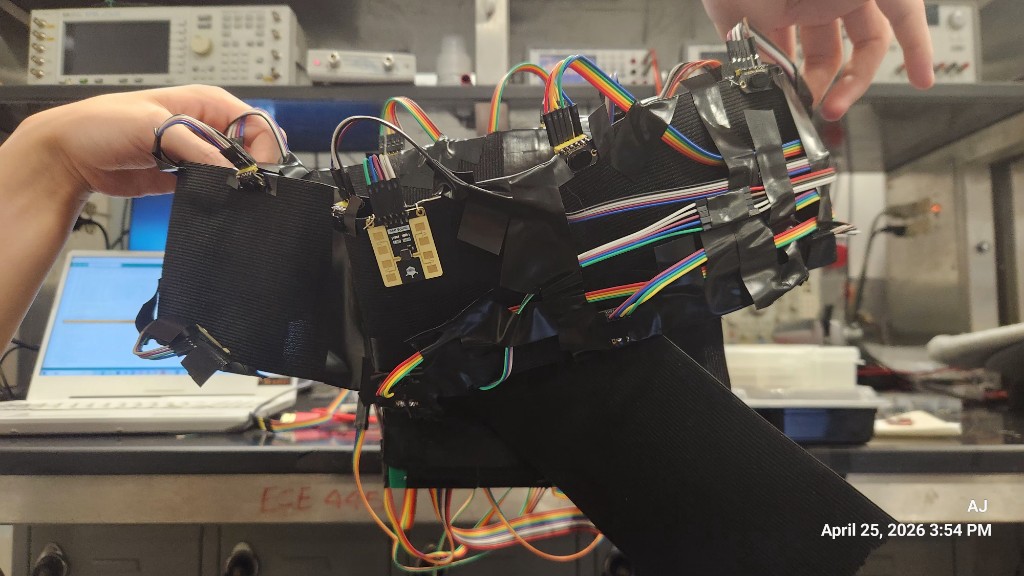
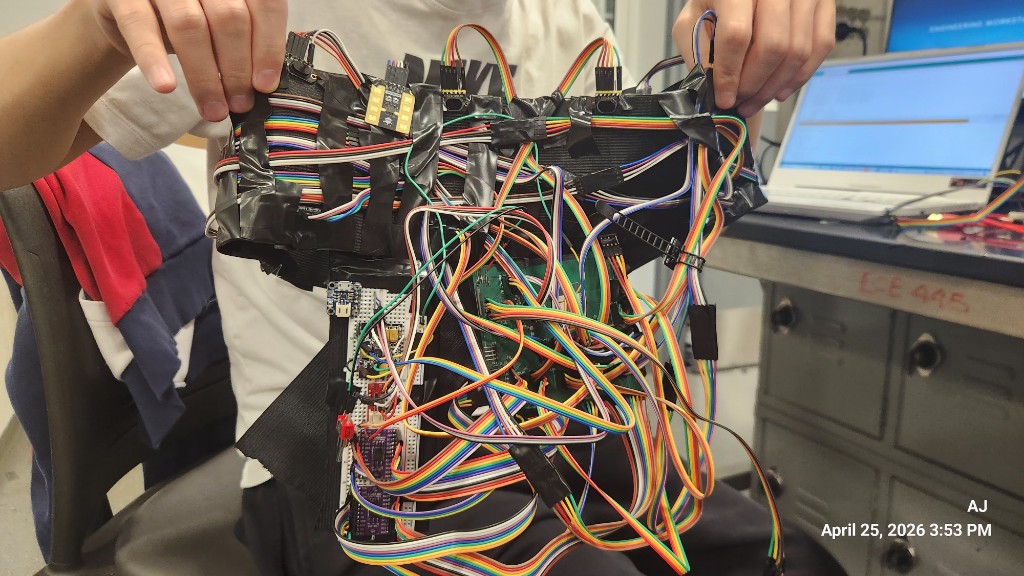
Technologies
ESP32-S3 · Embedded C++ · Python · Flask · Wi-Fi · JSON · VL53L1X ToF · 24 GHz mmWave · IMU · GPS · Haptic feedback · pytest